
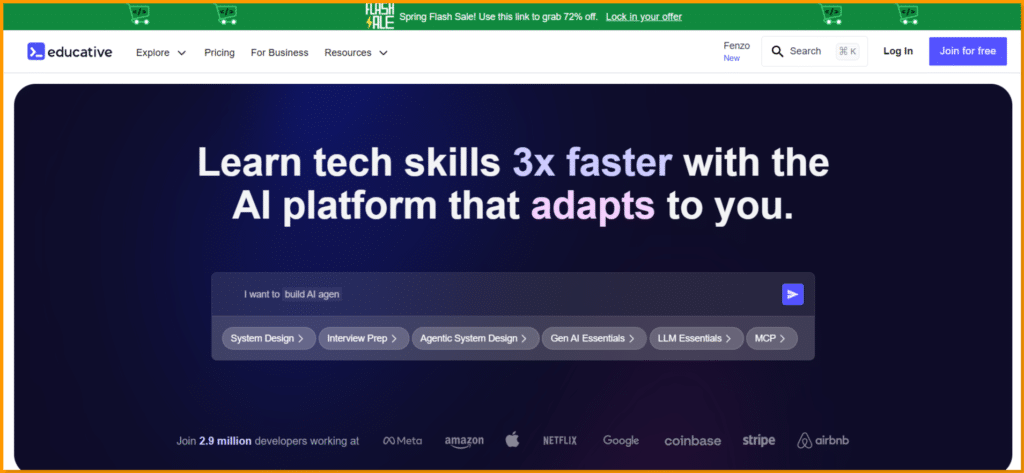
The online learning space for software developers has never been more crowded. Platforms like Udemy, Coursera, Pluralsight, and LinkedIn Learning compete fiercely for developer attention.
Yet Educative.io has managed to carve out a very specific, loyal niche, one that prioritizes reading, interactivity, and structured problem-solving over passive video watching.
Since its founding, Educative has become synonymous with technical interview preparation, especially for engineers aiming at roles in large tech companies.
What Is Educative.io?
Educative.io is an interactive, text-based online learning platform built exclusively for software developers and tech professionals.
Unlike the dominant model used by Udemy or Coursera, where learning happens by watching pre-recorded video lectures, Educative is built around reading, coding, and doing.
Every lesson is presented as rich text accompanied by embedded coding environments where learners write and execute code directly in the browser, without needing to install anything locally.
The platform was designed with a key frustration in mind: traditional video-based learning is slow, passive, and poorly suited to how developers actually absorb technical knowledge. Reading is faster than watching.
Being able to immediately test a concept in code reinforces understanding better than seeing someone else type. Educative leans hard into these truths and has built an entire platform philosophy around them.
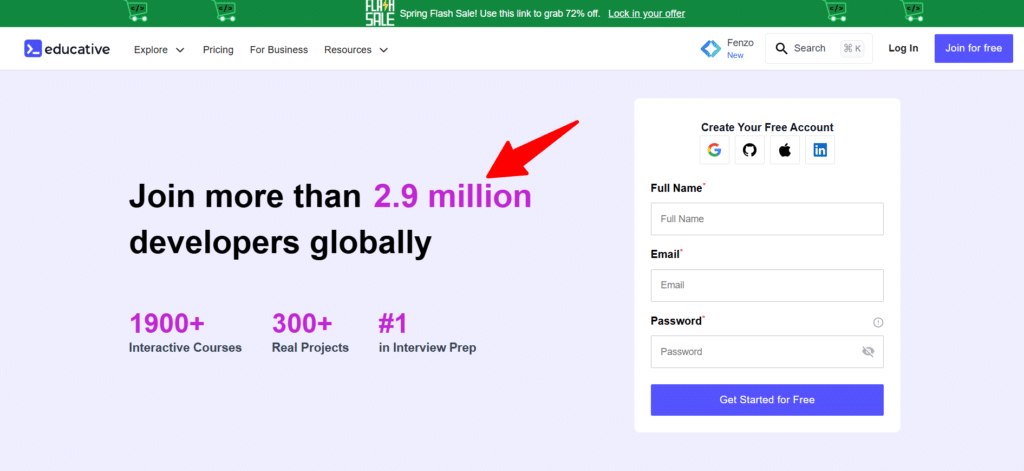
Today, Educative serves more than 2.8 million developers globally. Its learner base includes students preparing for their first developer jobs as well as senior engineers at Netflix, Meta, Apple, Google, and Amazon who use the platform for upskilling and interview preparation.
The Course Library: Breadth and Depth
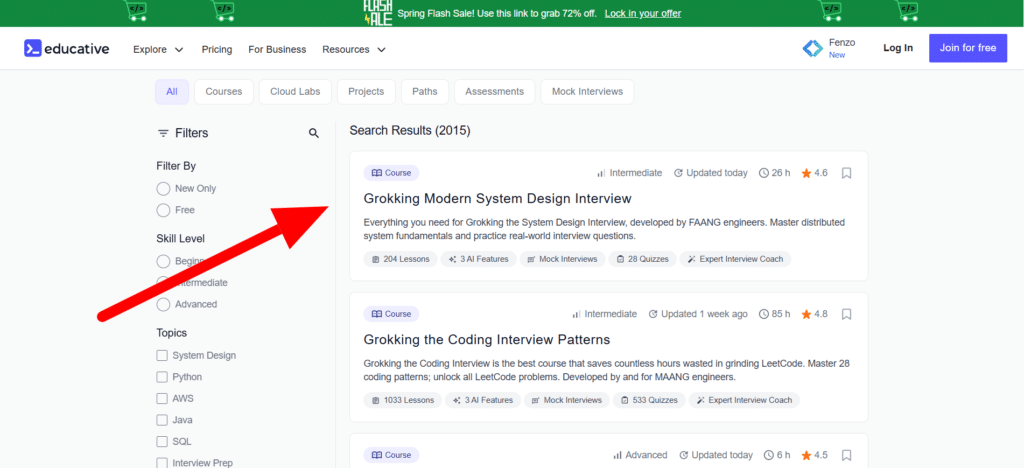
Educative’s catalog currently stands at over 1,600 interactive courses, and it continues to grow. The subject areas covered span the full landscape of modern software development.
| Category | What Educative Covers | Highlights |
|---|---|---|
| Course Library | 1,600+ interactive courses across modern software development | Constantly expanding catalog |
| Core Technical Topics | Data Structures & Algorithms, System Design, Programming Languages | Pattern-based DSA learning, strong system design reputation |
| Cloud & DevOps | AWS, GCP, Azure, Git, Docker, Kubernetes, Terraform, CI/CD | Certification prep, practical exercises, strong Kubernetes content |
| AI / ML & Development | Machine Learning, Deep Learning, Generative AI, Web, Mobile, Backend, Full-Stack | Covers React, Node.js, Django, Swift, Kotlin, and more |
| Advanced Learning | Real-world architecture, concurrency, scaling, distributed systems | Strong for interview prep and senior/staff-level engineers |
Data Structures and Algorithms form the backbone of the platform’s most famous content. These courses are structured around recognizing patterns rather than memorizing individual solutions, which is a fundamentally different pedagogical approach from grinding through hundreds of LeetCode problems in isolation.
Learners are taught to identify problem families, understanding, for example, that problems involving finding the maximum subarray of a specific size belong to the Sliding Window family, or that merging intervals is a recurring pattern that once recognized, unlocks dozens of variations. This pattern-based approach transfers extremely well to unseen problems in actual interviews.
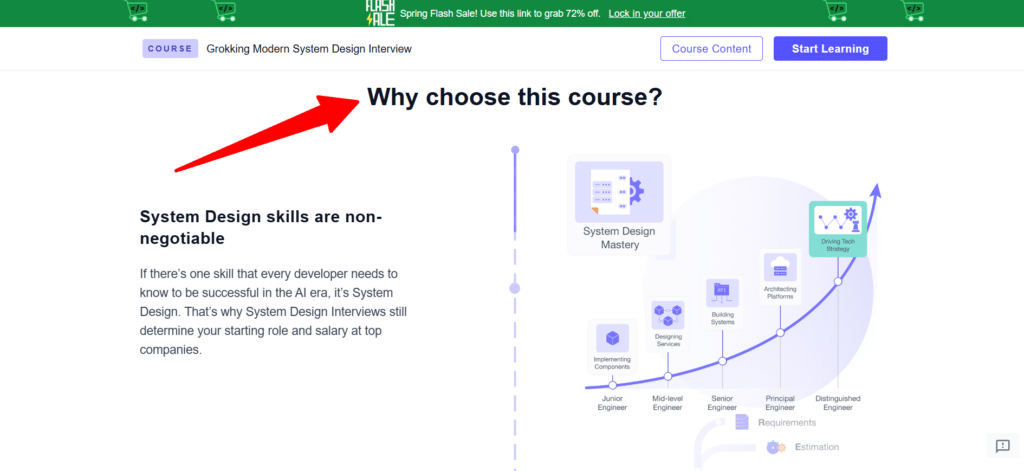
System Design is where Educative arguably holds its strongest reputation. Courses covering modern system design walk learners through the architecture of real-world distributed systems, covering load balancing, horizontal and vertical scaling, caching strategies, database sharding, message queues, and microservices.
Advanced topics like CAP theorem, consistency models, and trade-offs between availability and partition tolerance are treated seriously and in depth. For engineers targeting senior or staff-level positions, these courses are widely considered among the best available anywhere online.
Cloud Computing has become a major focus area for the platform. Educative offers dedicated learning paths for Amazon Web Services, Google Cloud Platform, and Microsoft Azure.
These include both foundational courses for beginners and certification-oriented content for engineers preparing for exams like the AWS Certified Solutions Architect, Associate, AWS Certified AI Practitioner, and similar credentials. Each lesson in these courses includes quizzes, mock exams, and practical exercises, and learners who complete the full path earn a completion certificate.
DevOps and Infrastructure courses are another strong category. Learning paths in this domain typically begin with Git fundamentals, branching strategies, commit history management, rebasing, and the underlying object model, before progressing into CI/CD pipelines, containerization with Docker, orchestration with Kubernetes, infrastructure as code with Terraform, and observability tooling.
The Kubernetes content in particular is thorough, moving from basic concepts and resources through to advanced topics like auto-scaling, monitoring, and troubleshooting pod failures.
Machine Learning and AI content has expanded significantly in recent years. Courses range from introductory machine learning with Python and scikit-learn, through to deep learning, natural language processing, and now generative AI.
Newer additions like Grokking Generative AI System Design reflect the platform’s effort to keep pace with what’s actually happening in the industry.
Web and Mobile Development courses cover frontend frameworks like React, Vue, and Angular; backend development with Node.js, Django, Flask, and Spring Boot; and full-stack patterns. Mobile development courses cover both iOS with Swift and Android with Kotlin.
Programming Languages are covered broadly, Python, Java, JavaScript, TypeScript, Go, C++, Rust, C#, and more. The Go advanced techniques course, for instance, dives into complex concurrency patterns, custom runtime behavior, and high-performance programming well beyond what introductory content usually covers.
What Are The Key Features Of Educative?
In-Browser Interactive Coding Environment
This is the platform’s most distinctive feature and the one that users most consistently praise. Every course that involves code, which is nearly all of them, embeds a fully functional coding playground directly alongside the lesson text.
Learners can write code, run it, observe the output, modify it, and experiment without ever opening a terminal, IDE, or separate browser tab.
This removes significant cognitive and logistical friction. Beginners don’t get stuck on environment setup issues before they’ve written their first line.
Experienced developers don’t need to context-switch between a browser tab and a local editor. The flow between reading an explanation and testing it in code is seamless.
The coding environments support multiple languages per course where relevant, and they come pre-loaded with any dependencies the course requires. For a Docker course, the environment has Docker installed.
For a machine learning course, NumPy, Pandas, and scikit-learn are already available. This is a meaningful quality-of-life advantage.
Structured Learning Paths
Rather than leaving learners to browse and self-assemble a curriculum, Educative offers curated learning paths, structured, sequential roadmaps for achieving specific goals.
These paths exist for outcomes like “Become a Backend Developer,” “Ace the Software Engineering Interview,” “Master DevOps,” or “Transition to Machine Learning.”
The AI-powered path personalization goes further. When you first set up an account and specify your current role, experience level, and learning objective, the platform creates a customized path tailored to your starting point.
An engineer with three years of backend experience preparing for a Google interview receives a different path than a computer science student preparing for their first internship application. The personalization is genuinely useful rather than superficial.
AI-Powered Features
Educative has integrated AI tools throughout the platform in several ways. The most notable is the AI mock interview feature, which simulates a technical interview based on the role and experience level you specify.
The mock interview creates a realistic interface, asks progressively harder questions, adapts based on your answers, and provides feedback. For engineers who don’t have access to peer mock interviews, this is a valuable practice tool.
The platform also includes Fenzo, an AI-powered tutorial generator. Learners can input a query or topic and receive a step-by-step tutorial on demand.
While it doesn’t replace curated courses for structured learning, it’s useful for quickly exploring a new concept or getting a custom explanation of something a course glossed over.
AI assistance is also embedded within courses in the form of hints, explanations, and debugging help for coding exercises.
Completion Certificates
Educative now issues official completion certificates for its courses. To earn a certificate, learners must complete the course and pass all associated exams and assessments.
The certificates are designed to be showcased on resumes, portfolios, and LinkedIn profiles. For free courses, the certificate itself costs a small fee to claim.
Early Access Courses
Annual plan subscribers receive access to courses that are still in development, typically two to three weeks before their official public release.
This “Early Access” feature appeals to learners who want to stay on the cutting edge of new topics and are comfortable with content that may still be receiving final polish.
Learner Streak Tracking
Educative tracks consecutive learning days in a streak system, creating a habit-forming mechanism that encourages daily engagement.
The streak is calculated based on daily activity including logging in, completing lessons, and passing assessments. This gamification element is modest but effective for learners who thrive on consistency cues.
Educative Pricing Plans Explained
| Plan | Price | Best For | Key Features |
|---|---|---|---|
| Standard | $59/month or $149/year | Beginners & students | Core courses, coding playground, learning paths |
| Premium | $99/month | Job seekers & interview prep | Full library, practice problems, 3 AI mock interviews/month, 270 projects |
| Premium Plus | Higher-tier plan | Advanced learners & cloud engineers | Everything in Premium + cloud labs, advanced tracks, more mock interviews |
| Other Offers | — | — | 7-day free trial, student offer via GitHub, 50%–72% discounts during sales |
Educative has moved to a three-tier subscription model: Standard, Premium, and Premium Plus. Each tier is available on monthly, annual, and two-year billing cycles.
Standard Plan is the entry-level subscription. The monthly cost is $59, and annual billing brings it down to $149 per year. The two-year option lowers the effective monthly cost further.
The Standard plan includes access to the core course library covering data structures, algorithms, programming languages, and popular frameworks, along with the in-browser coding playground and structured learning paths.
It is suited to beginners, students, and learners who want solid foundational content without advanced extras.
Premium Plan sits in the middle at $99 per month. This tier unlocks the full course library including premium-level courses focused on advanced topics and interview preparation.
It adds access to practice problems and assessments designed specifically for technical interview readiness, along with three mock interview sessions per month via the AI interviewer. The Premium plan also includes 270 real-world projects and personalized paths.
This is the most popular tier among active job seekers and developers preparing for senior-level interviews.
Premium Plus is the highest tier and is aimed at learners focused on advanced, career-oriented skills. In addition to everything in Premium, it unlocks cloud labs, live, hands-on lab environments where learners interact with real cloud infrastructure rather than simulated environments.
This is particularly valuable for engineers preparing for cloud certification exams or who need genuine hands-on cloud experience. Premium Plus also includes advanced learning tracks and additional mock interview capacity.
Educative frequently runs promotions and seasonal discounts. Black Friday, Cyber Monday, and holiday sales have historically offered discounts between 50% and 72%.
A 7-day free trial is available for users who want to explore the platform before committing. Students can also access free six-month access through a collaboration with GitHub.
Interview Preparation: The Core Use Case
Interview preparation is where Educative’s reputation was built, and it remains the platform’s strongest use case. The Grokking series, originally Grokking the Coding Interview, Grokking System Design, and subsequent additions, became the go-to resources for engineers targeting FAANG-level companies.
The philosophy behind these courses is pattern recognition: rather than brute-forcing hundreds of problems, learners master a set of fundamental patterns that underpin the vast majority of coding interview questions.
Educative’s current interview preparation section is organized around several modules. The coding interview module teaches patterns with increasing difficulty. The system design module walks through the architecture of real-world systems.
The behavioral interview module covers the STAR method and common behavioral question frameworks. The engineering management and leadership module serves senior individual contributors and engineering managers navigating leadership interviews.
The AI mock interview feature adds genuine value here, particularly for engineers who don’t have access to a study partner. Being able to simulate a realistic interview session, with an adaptive AI that reacts to your answers, pushes back on weak explanations, and probes for depth, is meaningfully different from reading about interview techniques. That said, it doesn’t fully replicate the unpredictability and social dynamics of a real interview with a human interviewer.
Community and User Sentiment
Feedback from the developer community is broadly positive but contains some recurring criticisms worth understanding in detail.
On the positive side, engineers consistently praise the quality of the system design content, calling it among the clearest and most practical available.
The text-based format is frequently cited as a major advantage, faster to consume than video, easier to search, and possible to complete in shorter sessions during a commute or lunch break. Many users credit specific Educative courses with helping them prepare for and pass interviews at major technology companies.
The structured learning paths receive praise from learners who find unstructured self-study difficult to sustain. Knowing exactly what to do next and being able to see measurable progress through a defined roadmap is genuinely motivating for many people.
On the negative side, the most common complaint concerns the subscription tier structure and what users describe as “hidden paywalls.” Some learners subscribe to the Standard or Premium plan believing they have access to the courses they specifically want, only to discover upon logging in that those courses require a higher tier. This mismatch between marketing language and the actual access level at each tier has generated significant frustration in communities like Reddit’s r/cscareerquestions.
The practical advice that surfaces consistently is to verify which specific courses are included in your intended plan before purchasing, rather than relying on broad language about “access to hundreds of courses.”
Customer support has also received criticism in some quarters. Billing issues — including confusion about renewal dates, promotional credits not appearing at checkout, and difficulty canceling subscriptions, have been reported. Response times from the support team have been described as slow in some cases.
A notable development worth addressing directly is the relationship between Educative and Design Gurus. The original Grokking the Coding Interview and Grokking the System Design Interview courses were created by Design Gurus and were, for years, exclusively hosted on Educative.
Design Gurus has since launched their own platform and sells those courses independently. Educative has created its own versions of these courses, but user opinion on how the new versions compare to the originals is mixed. Engineers who specifically want the original content should verify where it is currently hosted and in what form.
Educative vs. Competitors
Against video-based platforms like Udemy and Coursera, Educative holds a clear advantage for developers who prefer reading over watching. The ability to skim, search, bookmark, and annotate text-based content is significantly faster than scrubbing through video timelines.
The in-browser coding environment is also more seamlessly integrated than the typically separate setup required by video-based courses.
Against LeetCode, Educative serves a complementary rather than competing function. LeetCode provides breadth — a massive problem bank for repetitive practice. Educative provides depth and structure — pattern recognition frameworks and conceptual understanding that make LeetCode practice more efficient. Most engineers preparing seriously for competitive interviews use both: Educative to learn patterns and internalize approaches, LeetCode to drill those patterns at scale.
Against NeetCode, which offers free video-based pattern education combined with a curated LeetCode problem set, Educative’s advantage is its text format and the breadth of its non-interview content. NeetCode is an excellent free option for coding interview preparation; Educative adds value if the text-based format suits you better or if you also want cloud, DevOps, or system design content under a single subscription.
Who Should and Shouldn’t Subscribe Educative
Educative makes the most sense for engineers preparing for technical interviews at mid-to-large tech companies, especially at the senior level where system design depth matters.
It also makes strong sense for developers who prefer structured, text-based learning over video and want a single subscription that covers multiple skill areas.
The cloud and DevOps content in particular delivers genuine value for engineers working toward certifications or transitioning into infrastructure-heavy roles.
It makes less sense for learners who strongly prefer video instruction, who only need one or two specific courses (where individual purchase might be cheaper), or who are primarily looking for a large bank of isolated practice problems rather than conceptual education.
Final Verdict
Educative.io is a genuinely well-constructed platform with a coherent and defensible approach to technical education.
Its text-based, interactive model is faster and more flexible than video, the system design and interview preparation content is of real quality, and the AI features add meaningful capabilities that didn’t exist a few years ago.
It is not without legitimate criticisms. The subscription tier structure is confusing and has generated warranted frustration.
Customer support needs improvement. The original Grokking course situation introduces uncertainty for engineers who want that specific content.
And in the broader landscape, free alternatives have caught up considerably for pure coding interview preparation.
The honest bottom line: if you are a developer who prefers reading over watching videos, you are preparing for interviews at competitive tech companies, and you want a single platform that covers system design, cloud, and interview prep with structured paths and interactive coding, Educative offers strong value, especially at annual plan pricing during a promotional period.
Start with the free trial, verify the specific courses you want are accessible at your intended tier, and set a calendar reminder before your renewal date.
