
Udacity and Udemy share the first four letters of their names and not much else.
One is a curated, mentor-led program platform that charges a premium monthly fee and holds your hand through structured learning paths.
The other is a massive open marketplace where thousands of independent instructors sell courses at prices that regularly drop below the cost of a sandwich.
Choosing between them is less about which platform is objectively better and more about what kind of learner you are and what outcome you actually need.
This comparison breaks down both platforms across every dimension that matters and helps you figure out where your money belongs.
What Each Platform Actually Is
Understanding the core model of each platform clears up most of the confusion around this comparison.
Udacity is a structured learning platform built around a flagship product called the Nanodegree. Each Nanodegree is a curated, multi-month program covering a specific technical career path.
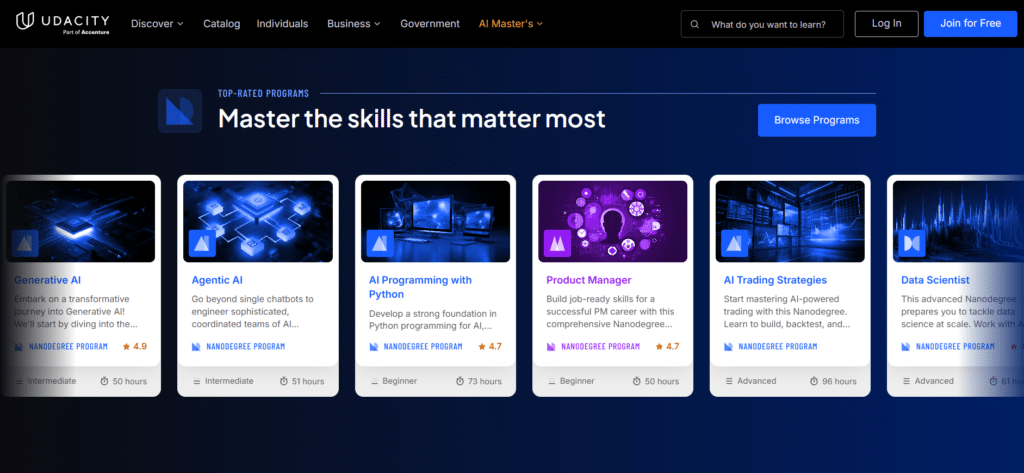
You pay a monthly subscription, follow a fixed curriculum, complete real projects that human reviewers give feedback on, and get one-on-one mentorship along the way.
The platform partners with major tech companies like Google, AWS, and IBM to build course content that reflects what the industry actually uses.
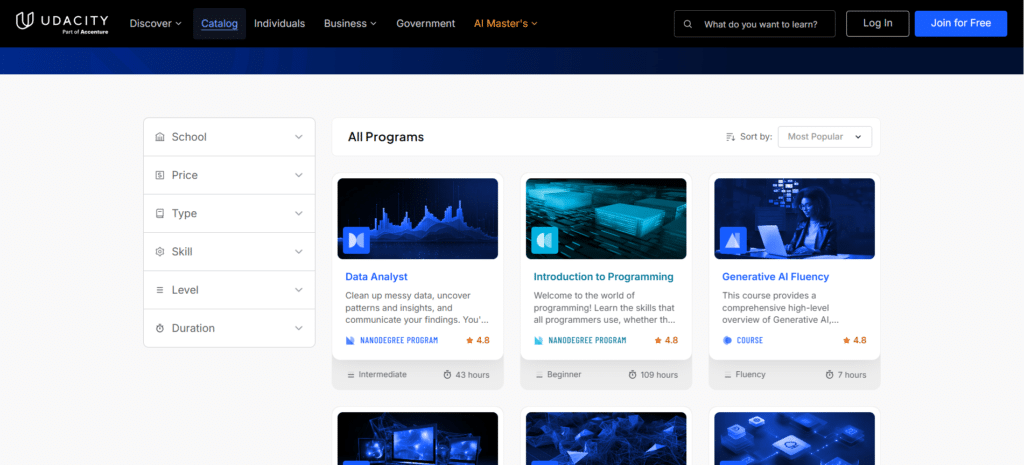
Udemy is an online course marketplace. Over 75,000 instructors have published more than 250,000 courses on the platform covering everything from Python programming to watercolour painting to plumbing basics. Udemy does not build the courses or set the curriculum.
It provides the platform, handles payments, and drives traffic. Instructors build and sell their own content. You buy a course once and own lifetime access to it.
These are fundamentally different business models, and that difference ripples through every aspect of the comparison.
Course Catalog: Depth vs Breadth
Udemy wins on sheer breadth by an enormous margin.
With over 250,000 courses spanning technology, business, creative skills, personal development, language learning, health and fitness, and more, Udemy covers more topics than any other single platform on the internet.
If a skill exists and someone has filmed themselves teaching it, there is a reasonable chance Udemy has it.
Udacity wins on focused depth within its areas of specialisation.
Udacity covers a narrow range of topics: data science, machine learning, AI, cloud computing, programming, cybersecurity, product management, and a handful of business analytics tracks.
Within those areas, the depth of each Nanodegree program goes considerably further than a typical Udemy course.
In practical terms:
| Udacity | Udemy | |
|---|---|---|
| Total courses/programs | ~200 Nanodegrees and courses | 250,000+ courses |
| Topics covered | Tech and business focused | Virtually everything |
| Depth per subject | Deep, structured programs | Varies widely by instructor |
| New topics added | Curated, selective | Constantly, marketplace model |
If your goal is to find a course on a highly specific niche topic (Japanese calligraphy, Adobe Premiere shortcuts, tax accounting for freelancers), Udemy probably has multiple options.
If your goal is a structured, employer-aligned program in machine learning or cloud architecture, Udacity’s focused catalog is more appropriate.
Learning Format: Structured Programs vs Individual Courses
This is the most meaningful difference between the two platforms, and it affects outcomes more than any other factor.
Udacity’s structured Nanodegree format:
- A fixed sequence of modules building on each other
- A defined program timeline (typically three to six months)
- Projects due at each stage of the program
- Human mentor check-ins throughout
- A final capstone project summarising the full program
The Nanodegree format works because it mirrors how actual job training works. You follow a path, build on what you just learned, apply it in a project, get feedback, and move forward.
The structure creates momentum that self-paced learning alone often struggles to maintain.
Udemy’s individual course format:
- Standalone courses with no fixed sequence (unless you choose to take a series)
- No defined completion timeline; go as fast or as slow as you want
- Video lessons with quizzes and some coding exercises
- No projects submitted for review (some courses include practice exercises)
- No mentor relationship
Udemy’s format suits people who can self-direct effectively and know exactly what they want to learn. It rewards motivated, organised learners. It tends to fail people who need external accountability or a roadmap to follow.
A telling pattern appears repeatedly in online learning communities: people buy several Udemy courses, watch the first two hours of each one, and never return to them. This is not entirely Udemy’s fault.
The format puts the entire responsibility for completion on the learner, and most learners underestimate how much structure they actually need.
Content Quality: Industry-Built Curriculum vs Independent Instructor Marketplace
Content quality on Udemy varies so widely that it is almost impossible to generalise.
At its best, Udemy hosts some genuinely excellent courses from experienced practitioners who know how to teach: Colt Steele’s web development courses, Jose Portilla’s Python and data science courses, and Angela Yu’s programming courses are widely recommended across developer communities and hold up well against far more expensive alternatives.
At its worst, Udemy has outdated courses covering deprecated tools and frameworks, courses recycled from YouTube with minimal added value, and instruction quality ranging from polished to barely comprehensible.
The rating system helps filter this. Courses with tens of thousands of reviews and ratings above 4.5 are generally reliable. Courses with few reviews or ratings below 4.0 need more scrutiny.
The problem is that quality can still vary within a highly-rated course, and outdated content sometimes keeps high ratings because students reviewed it years ago when the material was current.
Udacity’s content quality is more consistent because the platform curates its own curriculum, works with industry partners to shape it, and reviews content before publishing.
This does not mean every lesson is equally strong, but the floor is higher than Udemy’s because there is an editorial layer between the instructor and the student.
Project Work and Hands-On Practice
This comparison is not close.
Udacity: Every Nanodegree includes multiple graded projects submitted to a human reviewer. You build real things, a deployed machine learning model, a full-stack web application, a cloud architecture on AWS, and a qualified reviewer gives you written feedback with specific guidance on what to improve before you can advance.
This feedback loop is the single most valuable part of the Udacity experience and the thing that most directly prepares you for real job work.
Udemy: Project quality depends entirely on the individual instructor. Some courses include genuinely useful hands-on projects that you build alongside the instruction.
Many courses have exercises and quizzes but no project that produces a real output. Almost none include a human reviewer who gives feedback on your specific work.
For anyone building a portfolio for job applications, Udacity’s project-based model produces actual artefacts you can show employers.
Udemy’s model might help you understand concepts, but you leave with a certificate, not a portfolio.
Mentorship and Human Support
Udacity includes one-on-one mentorship as part of every Nanodegree subscription. You get scheduled video sessions with a mentor, the ability to ask questions between sessions, and career coaching as you approach graduation.
Mentor quality varies across Udacity’s network, and some students report more responsive mentors than others.
But having a real human available who knows the curriculum and can guide you through specific technical problems is meaningfully different from learning in isolation.
Udemy has no mentorship system. Instructors have Q&A sections inside their courses where you can post questions, and many instructors respond, some quickly and helpfully, others rarely or never.
The experience depends entirely on how actively the individual instructor monitors their course. For popular courses with large student bases, getting your specific question answered can take days or may never happen.
Certifications and Credentials: What You Get on Paper
Udacity awards a Nanodegree certificate on program completion. The credential is not an accredited academic degree, but it carries brand recognition in tech hiring circles, particularly for roles in data science, machine learning, and cloud.
Listing an AWS Cloud Developer Nanodegree or a Machine Learning Engineer Nanodegree on a resume communicates something meaningful to technical hiring managers at companies familiar with the platform.
Udemy issues a course completion certificate for every course you finish. These certificates are widely available, easy to earn, and carry limited weight on a resume in competitive hiring.
Hiring managers know that Udemy certificates represent self-paced video consumption rather than demonstrated skill, which limits how much work they do in an application.
Neither platform’s credential compares to a professional certification from the Linux Foundation, AWS, or Google Cloud.
But between the two, Udacity’s Nanodegree carries more weight in a technical hiring context.
Pricing: Monthly Subscription vs One-Time Course Purchase
The pricing models are completely different, which makes direct comparison complicated.
Udacity pricing:
- Monthly subscription per Nanodegree: approximately $249 to $399 per month
- Three-month program total: roughly $750 to $1,197
- Six-month program total: roughly $1,494 to $2,394
- Annual access options available on some programs at reduced effective monthly rates
Udemy pricing:
- Individual course prices range from $19.99 to $199.99 at list price
- Udemy runs frequent promotions that drop most courses to $9.99 to $14.99
- You buy once and own the course with lifetime access
- No subscription required for individual courses
- A Udemy subscription (Udemy Business or personal plans) gives access to a curated subset of courses for a flat monthly or annual fee
What this looks like in practice:
| Udacity | Udemy | |
|---|---|---|
| Entry cost | $249/month minimum | As low as $9.99 per course |
| Ownership model | Subscription (access ends if you cancel) | One-time purchase, lifetime access |
| Value for multi-topic learning | One subscription, one focus area | Buy multiple courses cheaply |
| Value for deep single-topic study | Stronger structure justifies cost | Good quality courses at low price |
Udemy’s pricing makes it exceptionally low-risk. Spending $12 on a course to see if you like a topic costs almost nothing. If the course helps, great. If it does not, the loss is minimal.
Udacity’s pricing makes it a significant financial commitment. The monthly fee creates pressure to study consistently and complete the program quickly, which can be either motivating or stressful depending on your circumstances.
Free Content: What Each Platform Offers at No Cost
Udacity offers a selection of free introductory courses covering Python basics, JavaScript, SQL, machine learning fundamentals, statistics, and Linux essentials.
These courses do not include project review or mentorship but cover genuine foundational content and give you a real feel for the platform before paying.
Udemy does not have a traditional free tier but offers a rotating selection of free courses that instructors make available as promotional tools to build their audience.
These courses vary in quality but can be genuinely useful for foundational topics. The free course selection changes regularly.
Both platforms give you enough free access to evaluate whether the teaching style works for you before spending money on either.
Career Support
Udacity includes resume review, LinkedIn profile guidance, GitHub portfolio feedback, interview preparation resources, and career coaching sessions as part of the Nanodegree experience.
It maintains relationships with hiring partner companies and gives graduates access to job postings from those partners.
Udemy offers no career support. It is a course marketplace, not a career placement service. Some individual instructors include job search tips in their course content, but there is no platform-level career infrastructure.
For learners actively looking for employment, Udacity’s career layer adds real value. For learners upskilling in a current role without actively job hunting, Udemy’s lack of career services matters less.
Udacity vs Udemy: Head-to-Head Summary
| Feature | Udacity | Udemy |
|---|---|---|
| Course catalog size | Narrow and curated | Enormous marketplace |
| Learning structure | Guided Nanodegree programs | Individual self-paced courses |
| Project feedback | Human reviewer on every project | Depends on instructor |
| Mentorship | One-on-one included | Not available |
| Content quality | Consistent, industry-aligned | Varies widely |
| Pricing | Premium monthly subscription | Low per-course purchase |
| Certificate weight | Recognised in tech hiring | Limited hiring credibility |
| Career support | Resume, coaching, hiring partners | None |
| Best for | Career transitions and deep skills | Broad skill exploration and specific topics |
| Free content | Introductory courses available | Rotating free courses |
Who Should Choose Udacity?
Udacity fits you if:
- You are targeting a specific technical role (data scientist, ML engineer, cloud developer) and want a structured path to get there
- You benefit from accountability and regular check-ins with a mentor
- You want projects you have actually built to show employers, not just a list of courses you watched
- You are prepared to invest serious time and money in a focused program and plan to complete it within the recommended timeline
- You are making a genuine career move and need a credential that communicates demonstrated skill
Who Should Choose Udemy?
Udemy fits you if:
- You want to explore a wide range of topics without committing to one direction
- You already have solid self-discipline and can complete a course without external accountability
- You are upskilling in your current role rather than making a major career change
- Budget is a priority and you want quality learning at a low per-course cost
- You need to learn a specific tool, language, or skill quickly rather than building toward a comprehensive program
Can You Use Both Platforms Together?
Yes, and many learners do exactly this.
A common approach is using Udemy to explore a field cheaply before committing to a Udacity Nanodegree. A $12 Python course on Udemy tells you whether programming is something you genuinely enjoy before you spend $750 on a three-month data science Nanodegree.
Using Udemy as a low-cost testing ground and Udacity as the serious investment once you know your direction is a smart sequence.
Another pattern is using Udemy to fill specific gaps during or after a Nanodegree. If your Udacity program covers machine learning broadly but you want to go deeper on a specific library or framework, a targeted Udemy course fills that gap cheaply without another full subscription commitment.
Final Verdict
Udacity and Udemy serve genuinely different needs, and the better platform for you depends entirely on what you are trying to achieve.
If you are making a serious career move into a technical field and need structure, feedback, mentorship, and a portfolio of real projects to show employers, Udacity delivers something Udemy simply cannot match at any price point.
The monthly cost is high, but it buys you a learning system with accountability built in and human support at every stage.
If you want to learn broadly, explore topics at low risk, or pick up specific skills quickly without a large financial commitment, Udemy’s enormous catalog and low per-course pricing make it one of the best value propositions in online learning.
The self-directed format rewards motivated learners and punishes those who need structure.
The most honest advice is this: if you have strong self-discipline and clear goals, Udemy can get you remarkably far for very little money.
If you know from experience that you buy courses and never finish them, Udacity’s structured format, mentor accountability, and project review cycle are worth the premium price, but only if you actually show up and do the work.
